
Baptism: What Is It and Why Does It Matter?
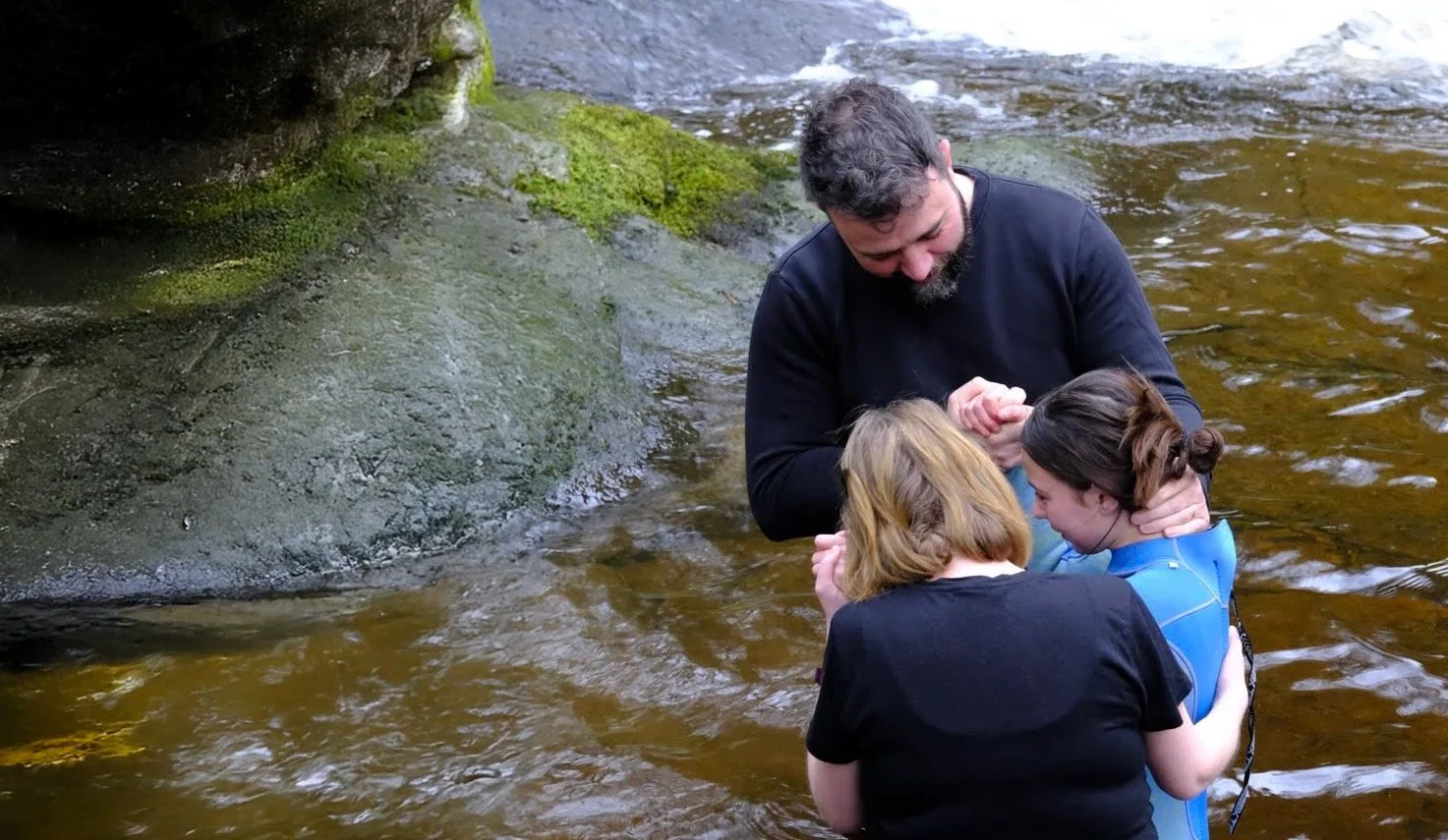
One of the most encouraging things in church life is seeing someone come to faith in Jesus.
There are moments you never really get used to. Watching someone discover the grace of God for the first time. Seeing the wonder in someone's face when they realise they are forgiven. Hearing them say, “I want to follow Jesus.” And one of the great privileges that comes after that moment is baptism.
Over the years I’ve had the joy of baptising friends, family members, and people whose lives have been completely changed by Jesus. Some of those moments are deeply personal. I once had the privilege of baptising my daughter Penny in the same river where my own father baptised me as a teenager. Standing in that water together was a moment I'll never forget.
Others have been slightly more improvised: We have baptised people in all sorts of places. The Liffey, the Irish Sea, the Canal. A bath in someone’s house, swimming pools and even a hot tub once. Pretty much anywhere we could find enough water and gather a few people together to celebrate.
The location never mattered much. What mattered was what was happening in a person’s life. Someone had met Jesus, and they wanted to publicly say, “I belong to him now.”
That’s really what baptism is about.
If you’d like to listen to a fuller conversation on this, we also recorded a recent episode of Liberty Conversations called What Baptism Really Means, where Noel Kenny and I talk through the meaning of baptism and share a few stories from the years.
What Is Baptism?
One of the questions people often ask when exploring Christian faith is “What is baptism, and why do Christians do it?”
At its simplest, baptism is an outward expression of an inward faith. It is a physical action that tells a spiritual story.
When someone is baptised they go down into the water and then come back up again. It is a simple act, but it carries deep meaning. The Bible describes it as a picture of death and resurrection.
The Apostle Paul writes in Romans 6:4:
“We were buried therefore with him by baptism into death, in order that, just as Christ was raised from the dead by the glory of the Father, we too might walk in newness of life.”
Going under the water symbolises the old life being buried with Christ. Rising from the water symbolises new life.
Baptism does not save us. Salvation comes through faith in Jesus. But baptism is the God-given way of publicly marking what has happened in a person’s life. It is a way of saying: Jesus has saved me. My old life is buried with him. I belong to him now. And I want to walk in the new life he has given me.
Because of that, baptism is not just a religious box to tick. It is something sacred. It belongs to God and should be approached with the seriousness and joy that come with obedience to Jesus.
At the same time, we do not need to overcomplicate it. In the New Testament, people did not wait for perfect conditions, perfect theology, or perfect feelings. When they came to faith in Jesus, baptism followed as a natural next step.
Why Baptism Matters
In the New Testament, baptism is closely tied to repentance and faith.
When people heard the message about Jesus in the book of Acts, their response was often simple and immediate. They turned to God and were baptised. Repentance means turning around. It means changing direction. It means that following Jesus is not just adding a new belief to your life. It is handing your life over to him.
So baptism is a declaration of allegiance. It is saying that Jesus is not just an inspiring teacher or an interesting historical figure. He is Lord. He is Saviour. He is King.
In that sense, baptism is a bit like wearing a wedding ring. A ring does not make someone married, but it publicly says, “I belong in this covenant now.” In the same way, baptism does not save us, but it does publicly declare that we belong to Jesus. It is a way of saying: I’m not keeping my options open. I belong to Jesus now.
Who Should Be Baptised?
Different Christian traditions approach baptism slightly differently.
In many churches, infants are baptised as a sign of dedication and blessing within the faith community. Often that comes from sincere faith and a genuine desire from parents to entrust their child to God.
At Liberty we practice what is often called believer’s baptism. That means baptism follows a personal decision to trust in Jesus.
The pattern we see most clearly in the New Testament is simple. People hear the gospel, respond in repentance and faith, and then they are baptised. That is why, in our church, we baptise those who have consciously turned to Jesus and want to publicly identify with him.
How Do We Baptise?
At Liberty we baptise by full immersion in water. That simply means a person goes fully under the water and is then raised up again.
We do this because it best reflects the picture we see in the New Testament. Baptism symbolises being buried with Christ and raised to new life, and full immersion expresses that picture clearly.
Throughout the New Testament, people are described as going down into the water and coming up out of it. So whether it is a river, the sea, a pool, or whatever else we can find, our practice is to baptise people by fully immersing them in water in the name of the Father, the Son, and the Holy Spirit.
Why Was Jesus Baptised?
People sometimes wonder why Jesus himself was baptised.If baptism is connected with repentance, and Jesus had no sin, why did he step into the water?
In Matthew 3 we read that Jesus came to John the Baptist to be baptised. John was surprised and tried to stop him, but Jesus insisted.
Part of the reason is that Jesus was identifying himself with the people he came to save. He stepped into the waters not because he needed forgiveness, but because he was fully embracing the mission the Father had given him.
He was also setting an example for those who would follow him.
At that moment something beautiful happens. The Spirit descends and the Father speaks: “This is my beloved Son, with whom I am well pleased.”
It reminds us that baptism sits within the life of the Trinity. The Father who loves us, the Son who saves us, and the Spirit who fills and transforms us.
Baptised Into a Family
Something we sometimes miss today is that baptism is not just about a personal moment with God. It is also about belonging to the people of God.
In the early church, when someone was baptised they were welcomed into the life of the community. They were not simply beginning a private spiritual journey. They were becoming part of a family.
Acts 2 describes what happened after the first baptisms in the early church. People devoted themselves to the apostles’ teaching, to fellowship, to breaking bread together, and to prayer. They shared meals, shared resources, and shared their lives.
The Christian life was never meant to be just “me and Jesus.” It is life with Jesus and his people.
At Liberty we take that seriously. We believe church is meant to be a real community where people practice the ways of Jesus together, encourage one another, forgive one another, and grow as disciples.
So when someone is baptised, we are not just celebrating an individual spiritual moment. We are welcoming someone deeper into the life of God’s family.
What Happens After Baptism?
Baptism is not the finish line of the Christian life.
It marks the beginning of a life of following Jesus. A life of learning his teachings, growing in prayer and Scripture, building relationships with other believers, and joining in God’s mission in the world.
At Liberty we want baptism to lead into deeper discipleship, deeper belonging, and deeper participation in the life of the church. Not standing on the edges, but moving in. Not simply attending, but becoming part of the family and learning to play your part in what God is doing.
Following Jesus is a lifelong apprenticeship. Baptism is one of the first public steps on that journey.
A Final Thought
Baptism is a serious and beautiful step.
It is a picture of death and resurrection.
It is an act of obedience.
It is a public declaration of faith.
It is a sign of belonging to Jesus.
And it is a step into the life of God’s people.
Again and again over the years, baptisms have become moments of celebration, laughter, testimony, prayer, and sometimes tears. Family and friends gather. The church rejoices. People hear someone say, often very simply, “Jesus has changed my life.”
So if you have trusted in Jesus, here is a simple question worth asking:
What is stopping you from being baptised?
